
- Mit Cisco Anyconnect Student
- How Can I Connect Via VPN To The MIT Network Using Windows 7 64 Bit?
- See Full List On Kb.mit.edu
AnyConnect supports script launching during WebLaunch and standalone launches. Cisco does not support example scripts or customer-written scripts. Retain VPN on Logoff. Keeps the VPN session when the user logs off a Windows operating system. User enforcement. Any User: Continues the VPN session even if a different user logs on.
| This article refers to the Cisco AnyConnect VPN. If you're looking for information on the Prisma Access VPN Beta that uses the GobalConnect app, see: Prisma Access VPN Landing Page. If you're not sure which service you're using, see: How do I know if I'm using the Cisco AnyConnect VPN or the Prisma Access VPN? |
- Cisco's AnyConnect VPN is a Virtual Private Network (VPN) client. For more information about VPNs, see: Virtual Private Network at MIT.
- In the Cisco AnyConnect Secure Mobility Client pane, click Disconnect. Figure 7: Close Cisco AnyConnect Secure Mobility Client. You are now disconnected from VPN. Mac OSX: To disconnect from a VPN connection on Cisco AnyConnect on Mac running Mac OS X or later: Click on the Cisco AnyConnect icon in your Dock. Click Disconnect.
On this page:
Primer
This guide will assist with the installation of the Cisco AnyConnect VPN client for Windows (Vista, 7, 8.1 and 10).
Installation
Mit Cisco Anyconnect Student
You need administrator level account access to install this software. When prompted with Windows UAC (User Access Control) you need to allow to install this software.
- Download the VPN installer from MIT's download page, Cisco AnyConnect VPN Client for Windows. Note:MIT certificates required.
- Find and double click the downloaded file named 'anyconnect-win-4.5.XXXXXX.exe', where XXXXXX is the sub-version number of the installer.
- On the following screen titled 'Welcome to the Cisco AnyConnect Secure Mobility Client Setup Wizard', click Next.
- When presented with the software license agreement, click I accept on the slide-down menu and click Next.
- Click Install when prompted (Note: the user must be an administrator of the machine to install).
Note: You may be warned the program comes from an unknown publisher and asked to confirm that you want to allow it to make changes to your computer. Click Yes to continue. - When installer begins installation you will see
- Click Finish when prompted to complete installation.
Connect
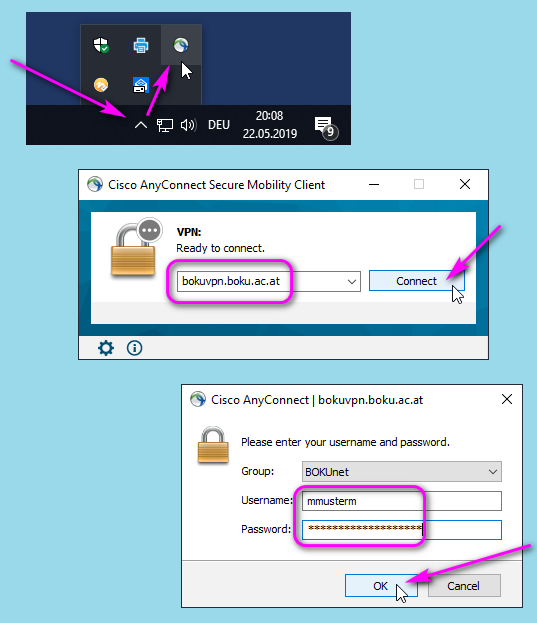
- Launch Cisco AnyConnect.
- Enter the address of the MIT Cisco VPN:
- Duo (two-factor authentication) required users must use: vpn.mit.edu/duo.
- Non-Duo (single-factor authentication): vpn.mit.edu
- Click Connect.
- When prompted, enter your MIT username and password.
- For Duo users, in the field labeled 'Second Password' you can enter one of the following options:
- push - Duo will send a push notification to your registered cell phone with the Duo Security mobile app installed
- push2 - Duo will send a push notification to your _second registered device with the Duo Security mobile app installed_
- sms - Duo will send anSMSto your registered cell phone; then enter that as your second password (you will fill out the login info twice with this method, first to get the sms code, then to enter it)
- phone - Duo will call your registered cell phone
- phone2 - Duo will call your second registered cell phone
- The one time code generated by your hardware token or the Duo Security mobile app (the code changes ever 60 seconds)
In this example, we've entered 'push' in the 'Second Password' field.
Sometimes methods with lag time, like Call, will time out before allowing you to complete Duo Authentication. SMS and one time codes generated by your hardware token (yubikey) or the Duo Security mobile app are the fastest methods and can help you avoid time-out issues.'How to call different devices'
If you have multiple devices that can use the same method, for instance two mobile phones or two phones that can receive phone calls, you can reference them by different numbers. For instance, to call the top device on your managed devices page (http://duo.mit.edu), you can use 'phone' (for the default) or 'phone1' to call the second phone, you can use 'phone2'.Zoom cloud meetings app download macsupernalcrown.
- In this example, you will receive a push notification on your cell phone. Click Approve.
- Cisco AnyConnect should now present you with the MIT VPN banner and the VPN connection will complete.
See Also
The Cisco AnyConnect Secure Mobility Virtual Private Network (VPN) Client provides privacy and security for your computing activities as well as the ability to access protected MIT resources that require a MITnet IP address such as fileshares, Forrester, and Remote Desktop.

Installation
To install Cisco AnyConnect Secure Mobility Client on your home computer follow these instructions from IS&T:
Mobile clients are also available:
How Can I Connect Via VPN To The MIT Network Using Windows 7 64 Bit?
Establishing a VPN Connection
Launch the Cisco AnyConnect Secure Mobility Client from the Start Menu on your Windows PC, the Applications folder on your Mac, or the launcher on your mobile phone
Enter the address:
vpn.mit.edu/duoMac medical stretcher manual head lift.Click Connect
When prompted, enter your MIT username and password
The 'Second Password' field required in step depends on what DUO Two-Factor Authentication devices you have enrolled at duo.mit.edu
- push - Duo will send a push notification to your mobile device with the Duo Security mobile app installed (expires quickly)
- sms - Duo will send an SMS to your registered cell phone
- phone - Duo will call your registered cell phone
- The one time code generated by your hardware token or the Duo Security mobile app (the code changes every 60 seconds)*
Click Accept
After a VPN connection is established you should be able to access fileshares, and Forrester from your OSATT laptop, or establish a Remote Desktop Connection from your home computer to your OSATT desktop.
See Full List On Kb.mit.edu
Having Trouble Printing?
Click on the Gear icon in the lower left of the Cisco AnyConnect Secure Mobility Client
Click on the Preferences tab
Check Allow local (LAN) access when using VPN (if configured)